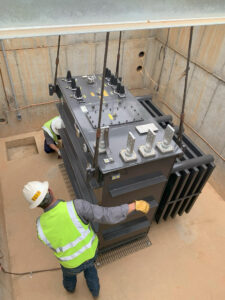
The electrical distribution team installs a transformer at the STEM + Agricultural Sciences Complex.
Just after 5 p.m. on what should have been a routine fall afternoon at Neville Arena, fans were filing in for senior night at the women’s volleyball game versus Texas when the unexpected happened: the lights went out.
Twenty five percent of campus, including Neville Arena and traffic signals along South Donahue Drive, suddenly went dark.
Immediately, Facilities Management’s Utilities and Energy Department personnel began to receive texts and emails from the electronic notification system. Facilities’ outage alerts then began going out to key contacts within the buildings affected, and line workers who had headed home for the day turned around and returned to campus.
By 6:10 p.m., about an hour after the initial failure and just 10 minutes past the
scheduled serve at Neville, the lights were back on. The match went on. Most fans never knew how close the university came to canceling an SEC sporting event.
And that is the point. Outages like this are rare, but when they occur, they are resolved in a timely manner. This allows the university to be able to fulfill its mission in a safe, comfortable and fully-powered environment.
What electrical reliability really means
For most of us, “electrical reliability” means lights, Wi-Fi, and heating and cooling systems that work when we need them. For Auburn’s Utilities and Energy team, it means something deeper:
Can Auburn operate?
Can classes continue, research stay protected and campus life run normally?
“If a building loses power, classes stop. Labs could lose critical research. Equipment faults cascade. The university’s mission stalls,” said Rob Engle, director of Facilities Management’s Utilities and Energy Department. “That is why Auburn’s electrical reliability isn’t just a technical metric; it’s a foundational measure of how dependably the university can function.”
Today, Auburn delivers electricity to campus with 99.99-percent reliability. This “four-nines” level of reliability equates to less than 52 minutes of unplanned outages per year campus-wide. That number is an industry gold standard, but it doesn’t happen by accident.
A system decades in the making
Auburn does not generate its own electricity. Alabama Power delivers high voltage electricity to three campus connection points—the Hemlock and Duncan substations serving main campus, and a dedicated feed for the College of Veterinary Medicine. From those points inward, everything else—lines, switches, transformers and the distribution network—belongs to the university, and is the responsibility of Facilities Management.
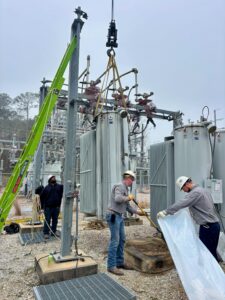
John Askew, Ruffin Duncan and Wesley Burt install a new voltage regulator at the Hemlock substation.
Auburn’s internal grid was designed with two guiding principles:
1. Build it underground whenever possible.
Unlike above ground systems vulnerable to storms, animals and tree limbs, Auburn’s underground distribution grid dramatically reduces outage risks.
2. Build it reliably.
If a single line or piece of equipment fails, the system can be “re-fed” from another direction.
“We have had a very smart and forward-thinking group that has helped us design our campus infrastructure to be reliable and resilient. It is built with backups, minimizing the down time and the people affected if we do have an outage,” Engle said.
This design allowed crews during the Neville Arena outage to move the impacted circuit from one side of the substation to the other, restoring power in about an hour, most of which was the drive time of line workers returning to campus.
“Building that capacity took decades of planning,” Engle said. “You can’t oversell the value of the people who came before us.”
The people behind the power
If the electrical system is Auburn’s backbone, the electrical distribution team is its beating heart.
Auburn’s electrical distribution team has six highly-trained and certified high-voltage line workers who maintain and repair the campus’ entire internal grid.
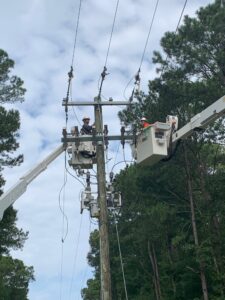
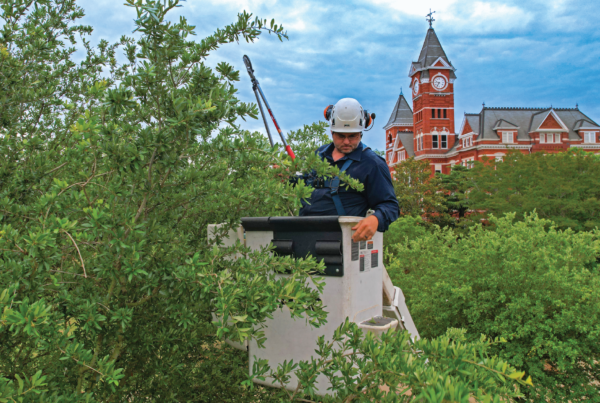
Maintaining Auburn’s power lines. From left: James “Ruffin” Duncan and Scott Morgan
“These are our first responders,” Engle said. “They are going out on campus and saving the day during an outage by troubleshooting the problem, figuring out a solution and executing the plan to bring power back up.”
If you ask the electrical distribution team, they’ll tell you they don’t need recognition, but they deserve it.
When outages happen, they’re the ones driving back to campus. They’re the ones opening cabinets in the dark, repairing damaged equipment, rerouting circuits and bringing buildings back online so students, faculty, fans, researchers and staff can do what they came here to do.
“Someone on our crew is on call after normal work hours each day of the week. If severe weather is predicted, or even if it’s not, we do our best to maintain our utility trucks, portable generators, high voltage tools, other equipment and materials to make any necessary repairs day or night,” said Keith Nall, supervisor of electrical distribution.
Their work is technical, physical, dangerous and mostly invisible. That is precisely because they are so good at it; outages are rare and brief.
“Usually, people don’t know we exist until the power goes out,” Nall said. “We are like the fire department. We might not get a call, but when we do, we all know we must resolve the problem as quickly as possible so that research and classes can continue.”
Every minute of every day, their work helps keep Auburn’s lights glowing, research running, fans cheering and classrooms humming.
Preventing problems before they happen
The university’s reliability isn’t just about fixing outages—it’s about preventing them.
“The preventive maintenance program is one reason our electrical reliability is so high,” said Ken Martin, Facilities Management’s director of Client Relations and former director of Utilities and Energy.
Every year, the electrical distribution team:
- Inspects transformer cabinets across campus.
- Checks for animal interference.
- Performs infrared thermal scans.
- Retires and replaces aging equipment.
“We also partner with Alabama Power to keep the trees and brush clear of power lines,” Martin said. “They will fly helicopters over their lines to conduct infrared scanning. Since our lines are fed by theirs, they will share if they see any abnormalities that could affect our reliability.”
Planning for Auburn’s continuing growth
Auburn’s campus continues to grow, and because of that, Utilities and Energy works continually with Facilities’ Planning, Design and Construction team to forecast future electrical demand to make sure the system can keep up with growth.
“We are always working to keep our system youthful and reliable,” said Ryan Landry, assistant director of Utilities and Energy. “We also continue to look ahead and plan for the future.”
Auburn’s 99.99-percent reliability isn’t luck.
It’s design.
It’s planning.
It’s constant maintenance.
And it’s the work of a small group of people who quietly keep the university running, no matter what.
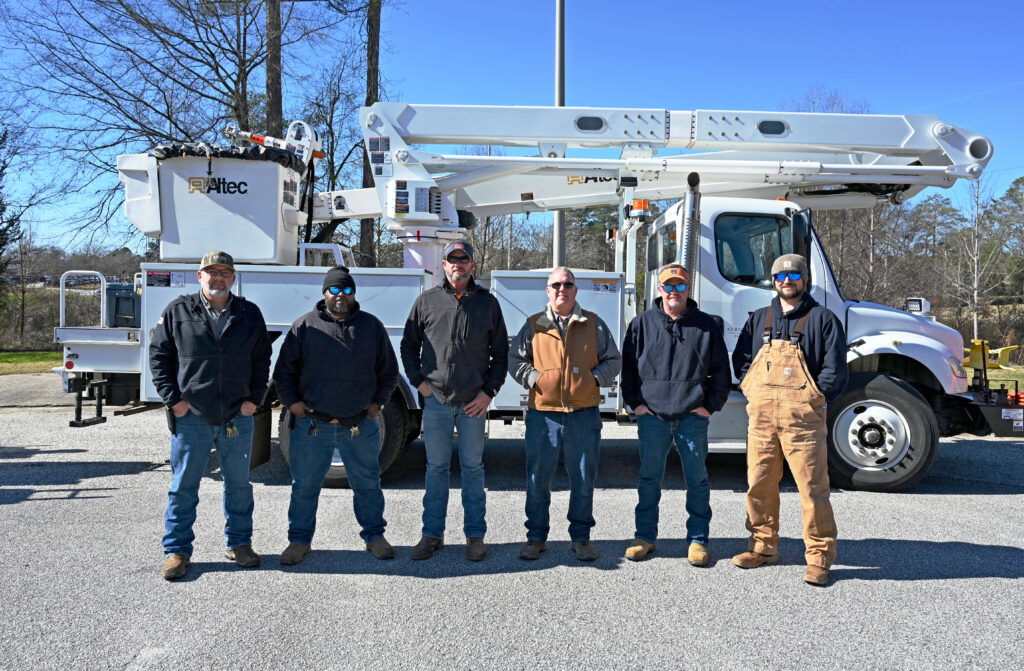
Auburn’s electrical distribution team keeps campus powered day and night. From left: Jonathan “Scott” Morgan, John Askew, James “Ruffin” Duncan, Keith Nall, Steven Neighbors and Wesley Burt.