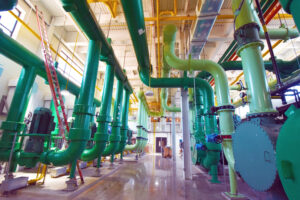
These green pipes within the Lem Morrison Chilled Water Plant help circulate chilled water throughout the south side of campus.
Auburn University has added 3 million square feet to campus since 2010.
This approximately 35 percent increase in space increased demand for energy from utility systems and buildings, but not by much.
Electricity and natural gas consumption only increased by about 7 percent in the same period.
Facilities Management’s energy efficiency efforts have allowed the university to avoid approximately $67 million in energy costs compared with what the university could have spent if energy consumption had followed the same trajectory as campus growth.
“That achievement is not the result of a single project or technology,” said Rob Engle, director of Utilities and Energy (U&E). “Instead, it reflects years of collaboration across Facilities Management and its campus partners to manage how buildings and utility systems operate.”
SMARTER SYSTEMS LOWER ENERGY USE
U&E’s Energy Management group has executed numerous energy savings projects over the last 20 years. Three key strategies have been effective at identifying and reducing energy consumption across campus.
Building scheduling
One of U&E’s most effective energy-saving strategies is also one of the simplest: Reduce heating and cooling in a building when no one is there.
U&E works with campus partners to understand when buildings are being used, then schedules how heating, cooling and ventilation systems are automatically adjusted. This lowers the amount of energy a building needs when it is empty but keeps it comfortable when it is occupied.
Building scheduling can reduce a building’s overall energy use by approximately 15 percent depending on the type of facility and how often it can operate in this energy-saving mode.
“During individual periods when a building is unoccupied, its energy use can be cut in half,” Engle said.
Central plant optimization
U&E has also focused on making the central plants that provide chilled water, hot water and steam to campus more efficient.
For example, the chilled-water system must coordinate chillers, pumps and cooling towers to cool buildings while using as little energy as possible. U&E teams have previously identified buildings that were using more chilled water than necessary and made improvements to help the entire campus cooling system operate more efficiently.
These benefits went beyond energy savings. With the system working properly, existing chillers could provide more cooling capacity. As a result, Auburn was able to delay the purchase of at least one additional chiller for several years.
“That is an important part of the university’s stewardship story: better operation of existing infrastructure reduces operating costs while also postponing major capital expenditures,” Engle said.
Existing building commissioning and fault detection and diagnostics
Energy Management specialists are also responsible for commissioning existing buildings, ensuring they continue to operate as designed. This can significantly reduce energy consumption and make the building more comfortable for its occupants.
This team also utilizes technology called fault detection and diagnostics (FDD), which has changed how U&E identifies energy waste inside campus buildings.
FDD analyzes information from building systems around the clock and looks for conditions that may indicate something is not working properly.
The system checks this information every five minutes and alerts the Energy Management team to potential efficiency problems, such as simultaneous heating and cooling, that a building’s occupants may not notice.
These FDD efforts have corrected over 1,500 building-system issues, making facilities more comfortable and resulting in significant energy reduction.
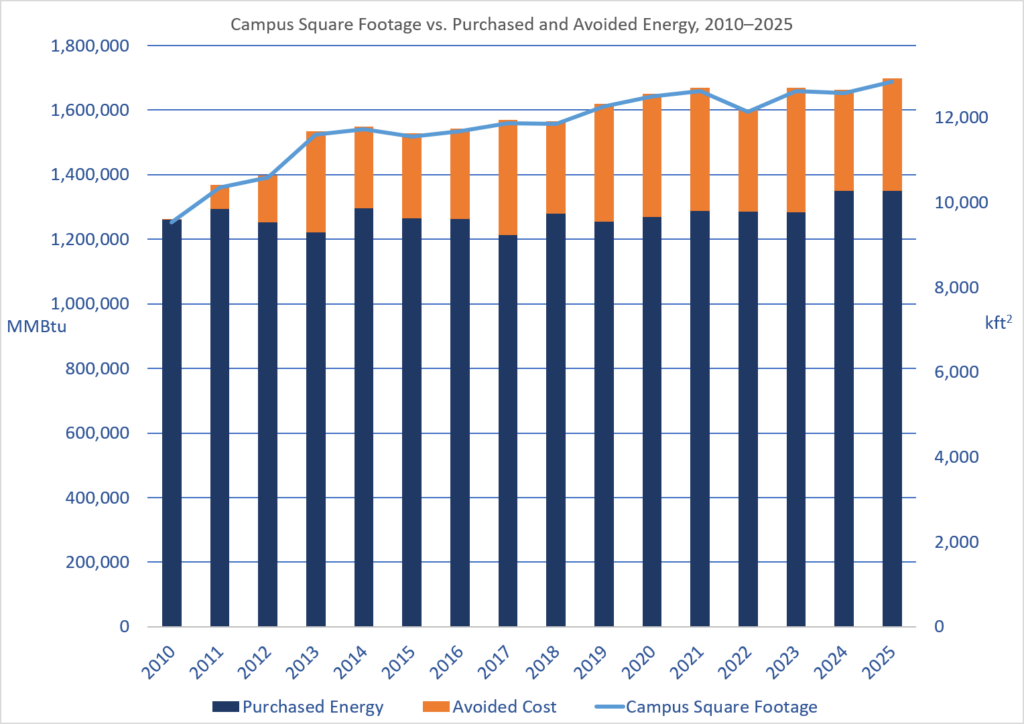
This graph illustrates how campus square footage has grown 35 percent since 2010, while purchased energy has only grown 7 percent. The gap (orange) shows energy avoided, which is worth $67 million since 2010.
BUILDING FOR LONG-TERM EFFICIENCY
Auburn’s newer buildings are also part of the story.
Modern buildings give Facilities Management tools that simply did not exist in many older structures: digital controls, occupancy sensors, more efficient heating and cooling equipment, improved insulation and glazing and significantly more data about how systems are performing.
U&E and Planning, Design and Construction (PD&C) work together throughout the process of designing a building. Project teams consider how everything from a building’s windows to its ceiling heights can lower heating, cooling and lighting costs.
“Energy efficiency is really considered from the beginning,” Simon Yendle, associate vice president of PD&C said. “It isn’t something we try to add at the end of the design.”
This comprehensive approach is especially important because different types of facilities have significantly different energy requirements. For example, classroom buildings typically consume less energy than laboratories or research facilities that require specialized ventilation, equipment and environmental controls.
“We don’t want to design a building in isolation,” Yendle said. “Our collaboration helps us make decisions that are good for the individual project and good for the campus as a whole.”
IN SUPPORT OF AUBURN’S MISSION
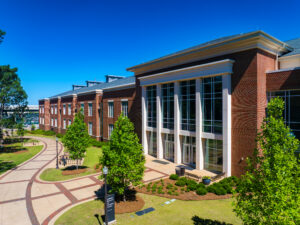
The Academic Classroom and Laboratory Complex, seen here, is LEED Gold certified. It is one of 15 LEED-certified buildings on campus, representing more than 1.4 million square feet of space. LEED certification recognizes buildings designed, constructed and operated to meet established standards for energy efficiency, water conservation, indoor environmental quality and overall sustainability.
Decades of thoughtful design, infrastructure investment and operational expertise, as well as collaboration among Facilities Management’s teams and their campus partners, have saved Auburn tens of millions of dollars since 2010.
This careful management of energy consumption allows the university to dedicate more resources for teaching, instruction and extension.
“Ultimately, we aim to be good stewards of Auburn’s resources while providing the facilities and infrastructure needed to support the university’s mission,” Yendle said.
As Auburn’s campus keeps growing, Facilities Management will continue to complete buildings efficiently, improve existing facilities and invest strategically in the utility systems and people that serve the university.