

Mary Melissa Taddeo, Capital Projects Studio Director.
When students return this fall, the new STEM + Agricultural Sciences Complex will feel polished, purposeful and ready for learning. What most won’t see is the months and, in many cases, years of careful coordination by Facilities Management teams working behind the scenes to prepare Auburn University’s largest academic project for occupancy.
Following spring graduation, about 300 faculty and staff representing multiple departments within the College of Agriculture and the College of Sciences and Mathematics will begin moving into the STEM + Agricultural Sciences Complex. For Facilities Management, the project represents one of the most complex academic moves in Auburn’s history.
Planning Long Before the First Box Is Packed
Facilities’ involvement began well before moving was on the calendar. Studio Director Mary Melissa Taddeo and Project Manager David Johnson from Planning, Design and Construction (PD&C) have been preparing for occupancy since the earliest design conversations.
“This project is massive,” Taddeo said. “We’re touching 11 existing buildings across campus—coordinating faculty, staff, labs and equipment—all within a single summer window.”
Those buildings include Parker Hall, Funchess Hall, Beard Eaves Memorial Coliseum, Haley Center, Rouse Life Sciences Building and several others. In some cases, entire academic programs are relocating. In others, labs, offices or specialized equipment are moving through carefully choreographed transitions, including instances where one department vacates a space so another can backfill behind them.
To manage the logistics, Taddeo maintains master spreadsheets tracking hundreds of occupants, rooms and destinations. Specialized move vendors handle general office contents and noncalibrated lab equipment, while departments coordinate highly sensitive scientific equipment moves requiring manufacturer oversight.
From Furniture to Functionality
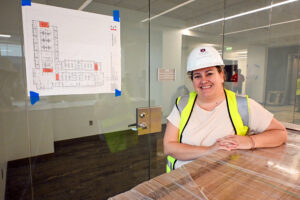
Whitney Brock managing the design, procurement and installation of furniture in the complex.
While logistics planning continues, another critical effort has been unfolding inside the buildings themselves: furniture installation.
Whitney Brock, a licensed interior designer and project manager with PD&C, has overseen what may be the largest furniture installation ever completed for an academic building on campus. Over four months, furniture from 23 manufacturers will be delivered by more than 45 trucks—35 of them 18-wheelers.
“Our goal is that spaces are truly move-in ready,” Brock said. “That means offices designed for current and future work styles, flexible classrooms, collaborative lounges and common areas that support how people actually use the building.”
Furniture planning involved mock-up reviews and a structured selection process to ensure office designs deliver functional and effective workspaces for faculty and staff.
Installations have begun while construction is still underway to meet the tight summer timeline, requiring coordination with contractors and traffic management for deliveries.
The College of Agriculture’s Horticulture Department is in the process of working with Facilities. The department will be moving almost 30 faculty and staff into Buildings B and C.
“The Facilities Management team has been excellent,” said Desmond Layne, head of the Horticulture Department. “We have had regular, scheduled and detailed updates … We have gone on three guided, hardhat tours so far as the building construction has permitted these. Every time we have had needs (e.g., boxing supplies) or questions, the provisions and answers have been swift and accurate. So far, we are very pleased.”
Keeping Campus Services Running While Preparing for the move
Facilities’ Campus Services departments have been heavily involved, balancing preparation for the new complex while maintaining daily operations across campus.
For Contract Services, that means planning custodial staffing and service levels. In total, six additional custodians are being added to the custodial contract, four assigned to night shifts and two during the day, to support the new complex once occupants arrive.
“Our focus is making sure cleaning services align with how each space will be used,” said Ryan Harris, assistant director of Campus Services. “We’re meeting with departments to talk through expectations, priorities and schedules and incorporating the facility into our quality inspection program from day one.”
Contract Services staff have already conducted walkthroughs to understand building layouts, flooring types, custodial closets and trash flow routes—details that affect long term custodial service quality.
Planning for What Gets Thrown Away or Recycled
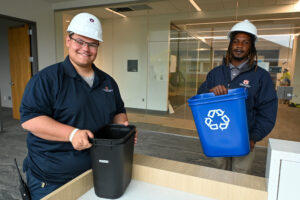
Antonio Lopez and Scott Floyd deliver waste and recycling bins to the new offices.
Every move generates waste, and for the Waste Reduction and Recycling Department (WRRD), preparation happens well before the first box is unpacked.
Joan Hicken, manager of the department, begins by studying floor plans, conducting walkthroughs and working with project managers to determine the proper mix of waste and recycling containers for offices, labs, common areas and outdoor spaces.
“This isn’t just about putting bins in a building,” Hicken said. “With the number of labs in STEM + Ag, there are special considerations that are part of the planning process.”
Her team delivers and lines hundreds of containers, coordinates large outdoor collection points and ensures recycling options are in place as furniture, equipment and boxes arrive. That work often overlaps with furniture installation, when contractors, vendors and Facilities staff are all working in the same space.
After occupants move in, WRRD shifts from setup to adjustment, observing how spaces are used and making changes where needed to support daily operations.
Making Sure the Mail continues to be Delivered
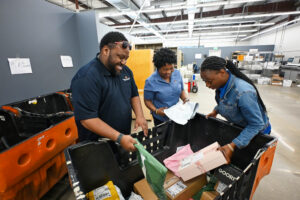
Anthony Driver, Lakendra Peavey and Shaniece Gray sort packages for campus delivery.
Mail Services is also preparing ahead of move-in, working with department contacts to determine mail delivery locations, access needs and routing changes.
“A new building affects how our entire delivery system runs,” said Anthony Driver, manager of Mail Services. “We’re planning ahead so when STEM + Ag comes online, it has a dedicated carrier and departments receive their mail without disruption.”
Depending on departmental needs, Mail Services may install centralized mail lockers or coordinate floor-based deliveries. Routes are recalculated, carriers reassigned and departments reminded to update their addresses—small steps that make a significant difference once a building opens.
A Summer of Coordination, with Fall in Mind
Occupants move-in will begin in mid-May and continue through the end of July, organized by building and floor, starting at the top levels and working down. The complex must be fully operational before the fall semester begins.
Through it all, Facilities Management staff are coordinating across departments—studio directors, project managers, custodial services, mail services and waste and recycling—while keeping the rest of campus running.
“As soon as we get the keys, our operations take over,” said Dee Sneed, director of Campus Services. “Our job is to bridge the gap between the vision of the designers and what it takes to operate and maintain the buildings every single day.”
When faculty and staff unlock their new offices and labs for the first time, the transition should feel seamless. Behind that moment are thousands of detailed decisions, countless walkthroughs and Facilities Management ensuring Auburn’s largest academic project is ready, not just to open, but to function for decades to come.