PLANNING, PRIORITIZATION AND FUNDING ARE KEY
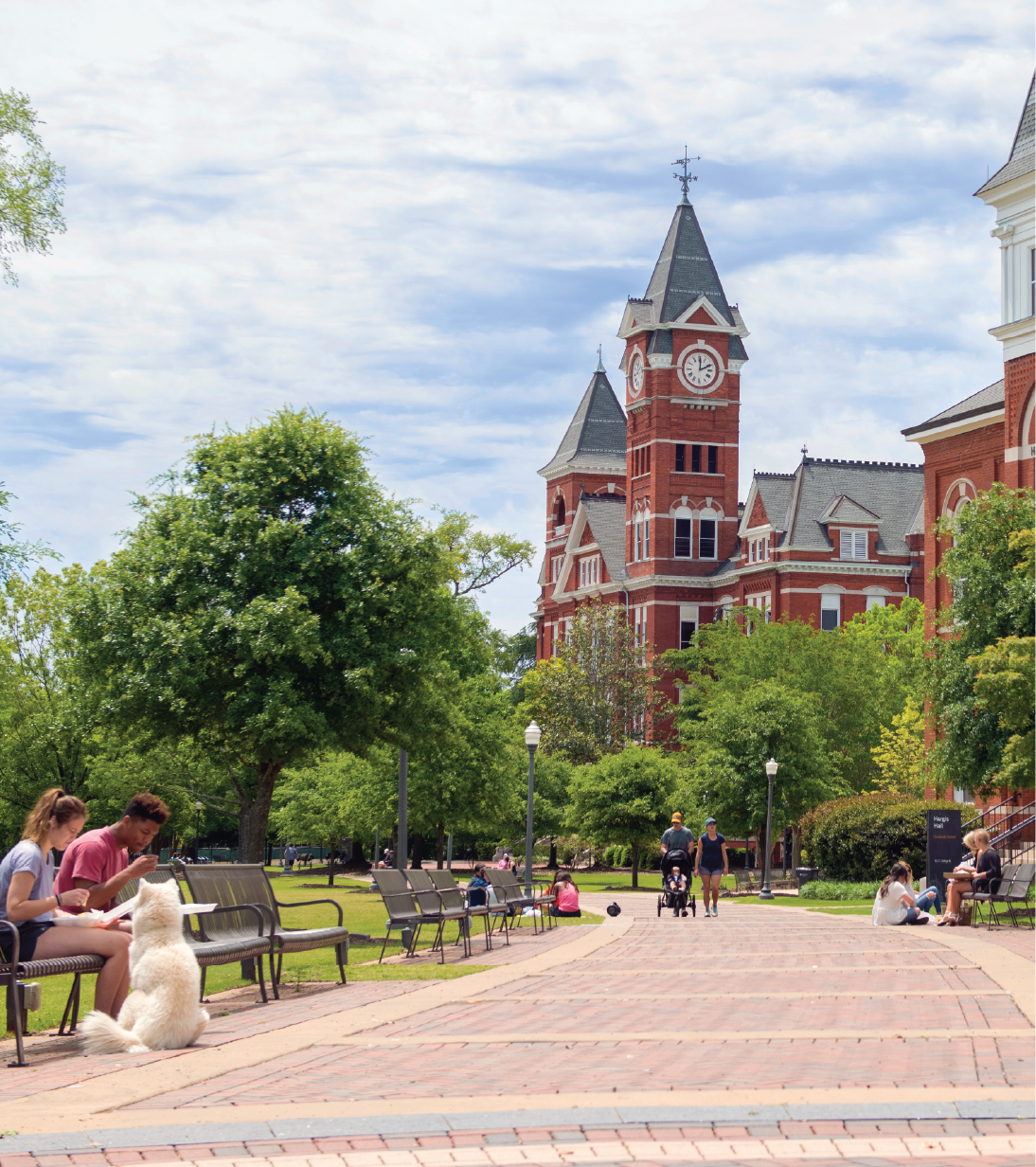
Auburn University’s main campus boasts more than 400 buildings, ranging from historic Samford Hall to the recently completed 167,000-square-foot College of Education facility. The campus also continues to evolve with the largest academic project in Auburn’s history—the STEM + Agricultural Sciences Complex—set to open in 2026.
Samford Hall
Like many universities, Auburn is facing a backlog of deferred capital renewal. This is a list of major maintenance, repairs, replacements and/or capital projects which historically have not been capital funded but will soon require
considerable attention.
Managing more than 13 million square feet of campus infrastructure while addressing the demands of aging buildings, evolving pedagogy and ever-changing technology presents a formidable challenge. Sustaining it requires much more, including strategic planning, prioritization and substantial institutional reinvestment to ensure the buildings continue serving faculty, staff, students, alumni and visitors years into the future.
While Facilities Management (FM) architects, engineers, maintenance technicians and project managers are working together to face the most critical challenges, the resources required to maintain and reinvest in campus infrastructure often far exceeds an institution’s available funding, with more than $1 billion required for the proper care of Auburn’s Educational and General buildings.
This is considered deferred capital renewal and is endemic to many postsecondary institutions, and Auburn’s campus is no different.
THE TRUE COST OF OWNERSHIP
“We buy what we’ve designed, we build what we’ve bought, we maintain what we’ve built, we renovate what we haven’t maintained and we demolish what we haven’t renovated.” Jim Carroll , vice president of Facilities Management.
Total cost of ownership for campus facilities encompasses utilities, maintenance and various modifications—such as program and code updates—along with other expenses. Owning a building requires a substantial financial commitment throughout its life cycle, often amounting to millions of dollars, to ensure its upkeep and continued programmatic educational functionality.
“If a building remains in use for 100 years, its initial cost—provided it is reasonable—is market-driven and aligns with inflation and the natural growth of money and value over time. Over a century, the amount invested in its design and construction accounts for less than 5 percent of its total long-term cost,” said Jim Carroll.
“Looking at Haley Center, it was originally built in 1969 for $6.5 million, and will have renovation costs that are expected to be 50 times that amount. Although expensive, the renovation expense represents less than 5 percent of the total investment over the next 100 years,” Carroll said.
THE FUTURE ARRIVES FASTER THAN EVER
Over the last 15 years, Auburn has added several technology-driven research and academic spaces to campus, including the Academic Classroom and Laboratory Complex, Advanced Structural Engineering Laboratory, and many others.
“We have been building tech-savvy buildings, that have hundreds of sensors with reporting capabilities in them,” Carroll said. “The technology in these buildings will need to be replaced much sooner than our older buildings.
“That is part of the challenge we face. Constructing these buildings is incredibly expensive, but in our effort to reduce utility costs, we are also shaping the lifespan of these facilities—both in terms of their overall durability and the longevity of their technological components.”
In short, if the university doesn’t plan and prioritize, newer buildings will come due for major renovations at the same time as older buildings.
“Where we really need to focus our attention now is on our older image and character buildings needing the most attention,” Carroll said.
FM is addressing this need with a tool that identifies buildings based upon their condition, helping to determine whether they require regular maintenance, major renovations or demolition.
STRATEGIC PLANNING
The Facilities Condition Assessment (FCA) is a nationally recognized systematic evaluation of a building’s physical state, considering factors such as age, design, construction methods and materials. It has been instrumental in helping FM assess the current condition of buildings and infrastructure, identify maintenance needs, and strategically plan for future repairs, comprehensive renovations or potential demolition.
Auburn’s FCA was developed by the university engineer, university architect, director of maintenance and zone maintenance managers within FM.
It took two years for university engineers to walk through each of Auburn’s 280 Educational and General buildings to determine their physical state.
“We walked through, shook the buildings down, emptied the pockets and took the change,” said Nolan Yon, FCA program manager within FM, who worked with a team of consultants, maintenance technicians and more to build the FCA database.
Yon and his team of technicians also receive real-time data on the state of each structure through project management software along with preventive maintenance reports and work order details also factored into the FCA.
“With the collected data, we make informed decisions about which campus assets require attention first,”
Yon said.
And many were in desperate need. The FCA ultimately helped determine that Auburn University’s facilities reinvestment need is in excess of $1 billion for the Educational and General buildings.
PRIORITIZING
Prior to the FCA, planning for campus renovation was more reactive, but now FM is taking a proactive approach by identifying the buildings and systems within based on their condition.
The FCA also assigned each building a Facilities Condition Index (FCI) score. A score greater than .4/1.0 means the facility is in poor to critical condition.
Structures identified as in critical condition were many of our image and character buildings most often attributed to Auburn’s history.
FM has a multi-disciplinary team of architects, engineers, project managers and others who are already at work on buildings identified as critical
by the FCA.
“We use the good work established by our FCA and FCI scores to inform us of when we should consider demolishing a building or to determine that a building needs a comprehensive renovation or a major systems renovation,” said Simon Yendle, associate vice president of Planning, Design and Construction within FM.
Examples of this include the STEM + Agricultural Sciences Complex which when complete in 2026 empties Beard-Eaves Memorial Coliseum, Funchess Hall and Parker Hall so each can be demolished.
The recently completed College of Education facility allowed its faculty, staff and students to move into the new building, which freed up 70,000 square feet in Haley Center so that the College of Human Sciences can move in while Spidle is being demolished. Spidle is being brought down so construction of the new College of Human Sciences Research and Academic Building can take place.
There are also plans to take down Terrell Hall once Campus Dining has been relocated. Its new location hasn’t been determined.
“The significance of taking down Parker, Funchess, the Coliseum, Spidle and Terrell is that it effectively represents a 20 percent decrease in our FCI score across the university,” Yendle said. “This means we will be taking the worst of the worst buildings offline and the amount of money we spend on energy and maintenance will be significantly lower.”
Comer Hall, which is set to bid soon, is the first of several comprehensive renovations to take place.
“We have a ‘top 10 buildings that need comprehensive renovations’ list. To date, we haven’t committed funding to do comprehensive renovations, so we see Comer as being the first,” Yendle said.
“We have several candidates after Comer. For example, Ramsay Hall, Haley Center, Mary Martin Hall and Upchurch Hall,” he said. “We are trying to develop a comprehensive renovation program that will allow us to, once a year, tackle one or two of these projects depending on available funding.”
INSTITUTIONAL REINVESTMENT
FM has taken a multi-year approach in deciding which structures were most in need and how to renew them for future generations of students. Targets have been chosen and plans are ready to be initiated, as soon as funding can be identified.
These older important Auburn structures must be maintained until we can fund their renovations. Demolition is another option, if the overall facility has outlived its use to the campus.