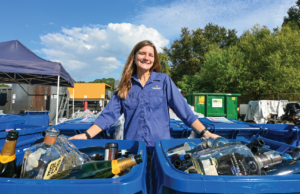
Cassidy Hartog prepares bins of collected glass for pick up.
Facilities Management is taking another step toward reducing waste and increasing sustainability on campus with the launch of a glass recycling pilot program.
Led by the Waste Reduction and Recycling Department (WRRD), the yearlong pilot program launched this semester will collect glass from select campus partners and the West Campus Community Drop-Off Center, diverting it from landfills to a regional recycling processor.
“The program is designed to test collection methods, evaluate recycling volumes and identify opportunities for future expansion,” said Cassidy Hartog, WRRD outreach and education specialist.
According to Hartog, WRRD has explored glass recycling in the past but faced a major challenge: a lack of nearby facilities capable of processing large volumes of glass.
The pilot became possible after Auburn identified Glass Half Full, a Gulf Coast-based recycling company with a processing center in Birmingham, Ala., that can handle large volumes of glass. Glass collected on campus will be processed for reuse, including conversion into sand for coastal restoration projects.
“The pilot currently focuses on a small group of participants whose operations generate significant amounts of glass,” Hartog said. “By starting with a limited number of locations, we can reduce contamination and monitor results before expanding the program to additional areas of campus.”
Among the first participants is Dudley Ankle, general manager for Proof of the Pudding, a company that supports premium hospitality areas in Jordan-Hare Stadium and manages large-volume food and beverage operations during athletic events.
“We order more than $30,000 worth of beverages in glass containers per football gameday,” Ankle said. “We looked at the amount of glass we were throwing away and realized we needed to start recycling. It is important as we want to reduce landfill waste and help preserve the planet for the future.”
Proof of the Pudding plans to recycle liquor bottles, wine bottles and food jars through the program and hopes to expand glass recycling to additional events in the future.
The pilot also includes Ariccia Cucina Italiana at The Hotel at Auburn University and Dixon Conference Center, as well as Walt’s on the Roof and 1856 at The Laurel Hotel & Spa.
These venues collectively generate more than 1,000 pounds of glass per month.
For Justin Philpot, director of rooms for The Laurel Hotel & Spa, participating in the pilot aligns with existing sustainability goals.
“Our organization is committed to sustainability and environmental stewardship,” Philpot said. “Participating in this pilot program aligns with our efforts to reduce waste, increase recycling initiatives and contribute positively to the environment.”
Philpot noted that the program also complements broader sustainability efforts already underway.
“We are passionate about providing sustainable practices that our team members can learn from and support,” he said. “Participating in this program allows us to further strengthen those efforts.”
Looking ahead, Hartog hopes the pilot will provide information needed to expand glass recycling to additional campus locations.
“I’d like to see the program expand across campus,” Hartog said. “While we’re just beginning with a small pilot group, the long-term goal is to make glass recycling accessible in residence halls and other campus locations.”
Over the next year, Facilities Management will evaluate participation levels, recycling volumes and contamination rates before determining future steps for the program. If successful, the pilot could serve as the foundation for a larger campuswide effort to divert more glass from landfills and support Auburn University’s sustainability goals.