When Cullen Kennedy graduated from high school, he knew he wanted to learn a trade but wasn’t exactly sure what the future would hold. Three years later, the electrical apprentice navigates buildings across campus troubleshooting complex electrical systems while learning from seasoned technicians who are passing along decades of experience.
The opportunity has not only taught him a profession but also helped shape his future.
Kennedy and other young trades professionals are building lifelong skills as part of the nationally recognized workforce development effort that recently earned Facilities Management APPA’s national 2026 Effective and Innovative Practices Award.
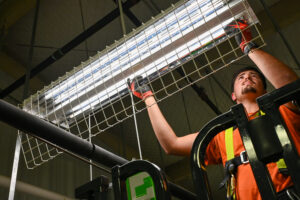
Cullen Kennedy, a 2025 Apprentice of the Year, changes a light in Building 6 at the Facilities Complex.
The award recognizes Facilities Management’s “Loveliest Pipeline on the Plains” workforce development model that combines registered apprenticeships, educational partnerships and community collaboration to create a sustainable talent pipeline at a time when the trades professions face a growing wave of retirements.
“As experienced plumbers, electricians and HVAC technicians retire and take decades of institutional knowledge with them, rather than simply competing for a shrinking labor pool, we have built a multi-layered system designed to cultivate talent from high school through full-time employment,” said Hayley Caver, Facilities Management manager of Human Resources. “The approach includes a registered apprenticeship program, community college partnerships and collaboration with local high schools.”
FROM VISION TO REALITY
The foundation for that pipeline was laid years before the first apprentices were hired.
“When I joined Facilities Management in 2018, our priority was meeting prospective talent where they are,” said Loren Winn, Facilities Management’s director of Human Resources. “We proactively partnered with local high school counselors to showcase high-value, viable career pathways for students eager to enter the skilled trades.”
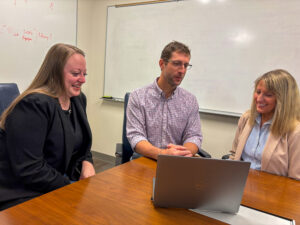
Hayley Caver, Dan Whatley and Loren Winn coordinate Facilities’ Workforce Development Programs.
As Winn met with educators, hosted campus tours and introduced students and parents to careers in facilities management, she realized many people simply didn’t know opportunities like these existed within a university setting.
“Many people simply don’t realize the breadth of skilled trade careers that exist within higher education. Higher education is often overlooked as a hub for skilled trade professions,” Winn said. “We recognized early on that raising awareness was critical to opening doors for individuals who hadn’t yet considered a university career.”
Those early efforts grew into Career Connections summer jobs program, expanded outreach to parents and counselors, and, eventually, a registered apprenticeship program developed in partnership with state officials. Together, those initiatives created a step-by-step pathway that allows students and young adults to explore careers, gain hands-on experience and advance into skilled trades positions.
CAREERS TAKING SHAPE
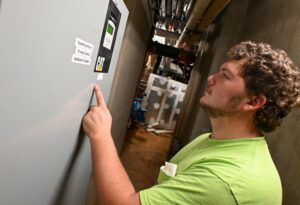
Connor Black, who started as an electrical apprentice in June, inspects electrical systems in the basement of the Walker Building.
According to Caver, the strength of the program comes from treating workforce development as an ecosystem rather than a single initiative.
“There are multiple programs, not just one,” Caver said. “We’ve built a culture where people are open to training others and investing in the next generation. Apprentices come into an environment where they’re treated as part of the team and the Facilities’ team is invested in their success.”
The impact of this pipeline can be seen in the experiences of employees such as Cullen Kennedy, Connor Black and Cole Witt.
Before becoming an electrical apprentice, Black participated in Facilities Management’s summer workforce development program while attending Auburn High School. He enjoyed the experience so much that he joined Facilities full-time in landscaping, where he spent nearly four years before applying for an apprenticeship position.
When an electrical apprenticeship opened, he seized the opportunity.
“I liked it [Facilities] so much that I ended up being full-time within just a couple of months after the summer program,” Black said. “Now I have the opportunity to learn electrical work, and that knowledge will stay with me for the rest of my life.”
For Witt, the pathway looked different. After serving four years as an Army Ranger, he enrolled in college but also wanted a career that combined continued learning with practical experience.
“I wanted something that would always be there, like a trade,” Witt said. “It’s a valuable profession.”
Since becoming a plumbing apprentice, Witt has also completed an associate degree, continued working toward a bachelor’s degree and gained real-world plumbing experience all while supporting Facilities’ campus operations.
BUILDING MORE THAN SKILLS
For Facilities Management, the benefits of these programs extend well beyond recruiting.
“We’re bringing in people that we’re able to train in the way we do things,” said Dan Whatley, associate vice president of Facilities Operations within Facilities Management. “They’re learning the trade and learning the campus at the same time. By the time they reach the journey level, they’re very well-rounded technicians because they’ve been developing those skills in Auburn’s environment from the beginning.”
Whatley said the program also strengthens the department’s culture by creating opportunities for experienced employees to invest in future generations.
“When we connected the idea that ‘someone invested in me and now it’s my turn to invest in someone else,’ there was a really strong connection,” Whatley said. “It has become part of the fabric of what we do.”
BUILT FOR THE LONG TERM
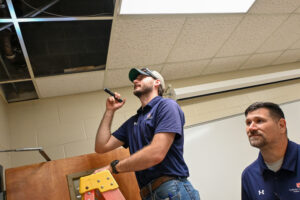
Plumbing apprentice Cole Witt and his supervisor Travis Tally inspect plumbing systems in Broun Hall.
“What we’re most proud of is seeing our feeder programs connect into the apprenticeship program,” Whatley said. “We’re starting to see the fruits of all those efforts and the connections between the different programs. If we can keep that pipeline moving, it’s an even bigger benefit to Facilities Management and a great benefit to individuals who may never have considered a career in the trades.”
The success of Auburn’s model has attracted attention beyond campus. Universities and organizations from across the country have contacted Facilities Management to learn more about the program and explore ways to adapt similar approaches within their own organizations.
For Caver, that growing interest reflects the broader value of the work.
“I love seeing the ripple effect that comes from giving people a chance to learn a trade,” Caver said. “Whether they’re here for a few years or for an entire career, we’re helping people build a foundation that impacts their families, their friends and their future.”
As the program continues to grow, Facilities Management leaders expect the pipeline to remain a critical part of preparing for future retirements, supporting campus growth and ensuring that skilled professionals are ready to maintain the university’s facilities for decades to come.
For Cullen Kennedy, the value of the experience is much simpler.
“If you learn a trade, I think that will benefit you for the rest of your life,” he said. “You’ll always have a job because people need electricians and plumbers and HVAC mechanics every single day.”