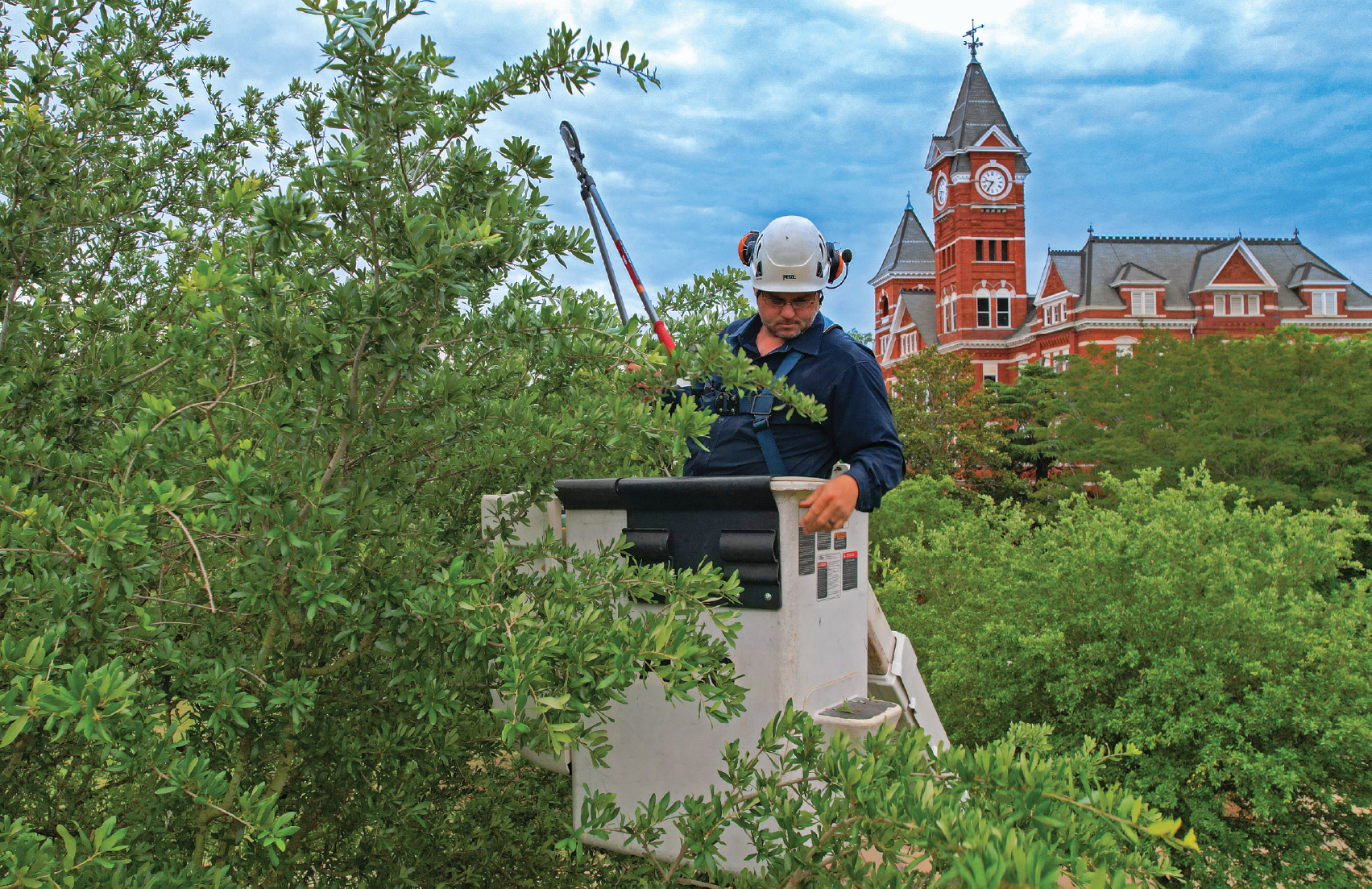

Andy Mora, arbor specialist
HOW AUBURN’S TREE CARE TEAM PROTECTS A CAMPUS LEGACY
Each day on campus, students gather under wide canopies for shade between classes, alumni return to familiar walkways lined with mature oaks and visitors pause to take in a landscape that has helped earn Auburn recognition as one of the most beautiful campuses in the country. Behind that beauty is a deliberate, science-driven effort led by Facilities Management’s Landscape Services tree care team—four professionals responsible for assessing and caring for more than 10,000 trees across campus.
Their work is not only about appearance. It is about safety, stewardship and a long-term commitment to a living landscape that holds meaning for generations of the
Auburn Family.
A PROACTIVE APPROACH TO TREE CARE
For University Arborist Alex Hedgepath, one of the most common misconceptions about tree care is that it is reactive, responding only after storms or visible damage.
“The general public tends to think of what we do as reactive when it’s really quite proactive,” Hedgepath said.
At the core of that proactive approach is a comprehensive tree risk assessment program. The team continually evaluates trees for structural integrity, health and surrounding conditions, identifying potential hazards before they become visible problems.
“We are intentional about strategic canopy preservation and growth,” Hedgepath said. “That includes pruning, root protection, planting and necessary removals, all with safety in mind.”
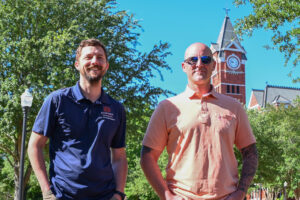
University Arborist Alex Hedgepath and Director of Landscape Services Justin Sutton
Director of Landscape Services Justin Sutton said that behind every tree on campus is a plan that is often decades in
the making.
“A lot of what we do is preserving what we currently have, especially mature trees, while also planning for the future,” Sutton said. “We’re thinking about what campus will look like 15 to 40 years from now.”
MANAGING RISK ACROSS A LIVING CAMPUS
Caring for more than 10,000 trees might seem daunting, but the team relies on a structured, three-level risk assessment system and years of specialized training.
Level one assessments involve routine walkthroughs or drive-through inspections to identify early signs of stress such as thinning canopies, discoloration or dieback. Trees flagged during this process are then evaluated more closely.
Dalton Sconyers, arborist and field supervisor, operates a bucket truck to safely prune branches.
Level two assessments take a deeper, ground-based look at individual trees, analyzing factors such as likelihood of failure and potential impact. These evaluations help determine a risk rating (low to extreme) and guide maintenance priorities.
“If there’s a risk of failure, we’re asking what could happen and how severe that impact would be,” Hedgepath explained.
Level three assessments involve more advanced diagnostics, such as examining internal decay or exposing root systems when additional data is needed.This structured process allows the team to focus resources where they matter most especially in high-traffic areas like Samford Park, concourses surrounding Jordan-Hare Stadium and the Tiger Walk space.
“It’s really based on how the space is used,” Hedgepath said. “Areas with constant activity get more frequent inspections.”
PREVENTING PROBLEMS BEFORE THEY HAPPEN
One of the clearest measures of success for the team’s work is what doesn’t happen.
“We have a lot of storms come through,” Sutton said. “People may not realize we don’t spend days cleaning up fallen limbs, and a lot of that is due to the risk assessment and pruning already taking place.”
A SMALL TEAM WITH A BIG IMPACT
Despite the size and complexity of Auburn’s campus forest, the core in-house team consists of just four people: Hedgepath; Dalton Sconyers, field supervisor and certified arborist, and Welsey Farrow and Andy Mora, both arbor specialists.
Together, they handle the most technical work, particularly in high-traffic areas where precision and experience are critical. Their expertise is supported by ongoing training, collaboration with campus partners and a network of Landscape Services employees who help identify potential concerns.

Arbor Specialist Andy Mora prunes an oak tree adjacent to the stadium.
“It’s boots on the ground every day,” Hedgepath said. “We rely on others across campus to let us know when something doesn’t look right and we always check it. It doesn’t matter if it is a tree that I know has been naturally leaning for 20 years, if I receive a request, I will visit the tree.”
All tree data including inspection records, maintenance history and risk assessments is tracked in Tree Plotter, a digital platform, allowing the team to monitor individual trees over time and continue to make informed decisions.
BALANCING SAFETY, BEAUTY AND TRADITION
Beyond safety, the tree care team plays a vital role in preserving the character of Auburn’s landscape.
The university’s Tree Campus Higher Education designation from the Arbor Foundation reflects that commitment. It also underscores the importance of maintaining a diverse, healthy canopy that contributes to Auburn’s identity.

Arbor Specialist Wesley Farrow trims one of the descendant oaks in Samford Park.
Tree selection and placement are handled with the same care as risk assessment. Native species are prioritized for longevity, and each planting is evaluated based on location, soil conditions and future growth.
“Not every open space is the right place for a tree,” Sutton said.
The team also works closely with Facilities’ Planning, Design and Construction Department and the university’s Tree Preservation Committee (TPC) to ensure trees are protected during development and integrated into long-term campus plans.
COLLABORATION WITH THE TPC
Tree removal is permitted in certain cases; however, the university prioritizes preservation through a formal policy governing the maintenance, protection, and removal of trees and establishing the TPC. All removal requests are reviewed by the committee, which includes Amy Wright, Ph.D. (College of Agriculture), Beau Brodbeck Ph.D. (Alabama Cooperative Extension System), and Dean Janaki Alavalapati (College of Forestry, Wildlife and Environment). The committee works collaboratively with the tree care team and Facilities Management leadership, including Vice President Jim Carroll and University Landscape Architect Judd Langham, to evaluate and process
each request.
“The Tree Preservation Committee brings together an exceptional group of experienced and highly respected professionals whose expertise and institutional knowledge ensure thoughtful, well-informed decisions,” Langham said. “Our long-standing relationships have built trust that makes collaboration seamless, productive and consistently collegial.”
The TPC is a critical component of the tree care process, providing leadership and informed decision-making that supports the long-term stewardship of the campus tree canopy.
PLANNING FOR GENERATIONS TO COME
At its core, Auburn’s approach to tree care is rooted in long-term thinking.
“Some of the trees we plant today, we may never see at maturity,” Sutton said. “But future generations will.”
That perspective shapes every decision—from preserving historic trees to selecting species that will thrive decades from now.
For the tree care team, each tree represents more than a data point or a maintenance task. It is part of a living landscape that defines the Auburn experience—one that alumni carry with them long after graduation.
Through careful planning, constant monitoring and a deep understanding of both science and tradition, the team ensures that Auburn’s trees continue to provide shade, beauty and connection for years to come.